GPT-6.2 pricing: Astra vs Sol compared with Claude and Gemini
GPT-6.2 pricing explained: what Astra and Sol cost per million tokens, how they compare with Claude and Gemini, and what a typical monthly AI bill looks like.
Written by Rron Rama
7 min read

In this article
The short version
GPT-6.2 Astra costs $8 per million input tokens and $40 per million output tokens, 20% less than GPT-6 Astra, while GPT-6.2 Sol stays at $2 and $10. That puts Astra level with Claude Fable 5.2, twice the price of Claude Opus 5.5, and Sol level with Claude Sonnet 5.5.
GPT-6.2 pricing comes in two tiers. GPT-6.2 Astra, OpenAI's most capable model, costs $8 per million input tokens and $40 per million output tokens through the API, 20% less than GPT-6 Astra. GPT-6.2 Sol, the everyday model, keeps its price of $2 and $10.
Those numbers mean little on their own, so this article puts them next to Claude and Gemini, works through what a realistic monthly bill looks like, and explains which tier makes sense for which job. All prices are list prices in US dollars as of November 23, 2026.
What did OpenAI release with GPT-6.2?
OpenAI released GPT-6.2 Astra and GPT-6.2 Sol in November 2026. According to OpenAI's announcement (opens in a new tab), both models are available to Plus, Pro, Enterprise, and Edu users in ChatGPT Work and Codex, and in the API as gpt-6.2-astra and gpt-6.2-sol.
Astra is the model for hard, multi-step work: long coding tasks, research, and agents that run for a long time. Sol is the lower-cost model for most everyday requests. OpenAI says Sol "carries forward GPT-6.1 Sol's rates", so only Astra got cheaper.
How much does GPT-6.2 cost per million tokens?
API models are billed per token, a chunk of text of roughly three quarters of a word. Input tokens are what you send (your prompt, documents, and conversation history) and output tokens are what the model writes back. Cached input is text the model has seen recently, such as a long system prompt that repeats with every request, and it is billed at a steep discount.
| Model | Input | Cached input | Output |
|---|---|---|---|
| GPT-6.2 Astra | $8.00 | $0.40 | $40.00 |
| GPT-6 Astra | $10.00 | not stated | $50.00 |
| GPT-6.2 Sol | $2.00 | $0.10 | $10.00 |
Prices are per million tokens. The GPT-6 Astra row is worked out from OpenAI's statement that GPT-6.2 Astra's prices are 20% lower.
OpenAI also claims Astra does more with fewer tokens. On its GDPval v2 evaluation, it reports that GPT-6.2 Astra used 22% fewer output tokens than GPT-6 Astra for the same tasks. If that holds for your workload, the real saving is larger than the 20% price cut, but it is OpenAI's own measurement, so test it on your own prompts before you budget on it.
GPT-6.2 vs Claude and Gemini: which AI API is cheapest?
The fairest comparison is tier against tier. The table below lists the current flagship and mid-range models from OpenAI, Anthropic, and Google. Claude prices come from Anthropic's pricing page (opens in a new tab). Gemini 4 Neon was released on November 18, 2026, and its price is reported by Android Headlines (opens in a new tab); we could not open Google's own announcement to confirm it.
| Model | Company | Input | Cached input | Output |
|---|---|---|---|---|
| GPT-6.2 Astra | OpenAI | $8.00 | $0.40 | $40.00 |
| Claude Fable 5.2 | Anthropic | $8.00 | $0.20 | $40.00 |
| Claude Opus 5.5 | Anthropic | $4.00 | $0.20 | $20.00 |
| Gemini 4 Neon | $3.00 | $0.15 | $15.00 | |
| GPT-6.2 Sol | OpenAI | $2.00 | $0.10 | $10.00 |
| Claude Sonnet 5.5 | Anthropic | $2.00 | $0.10 | $10.00 |
| Gemini 4 Hydrogen | $1.50 | not stated | $7.50 |
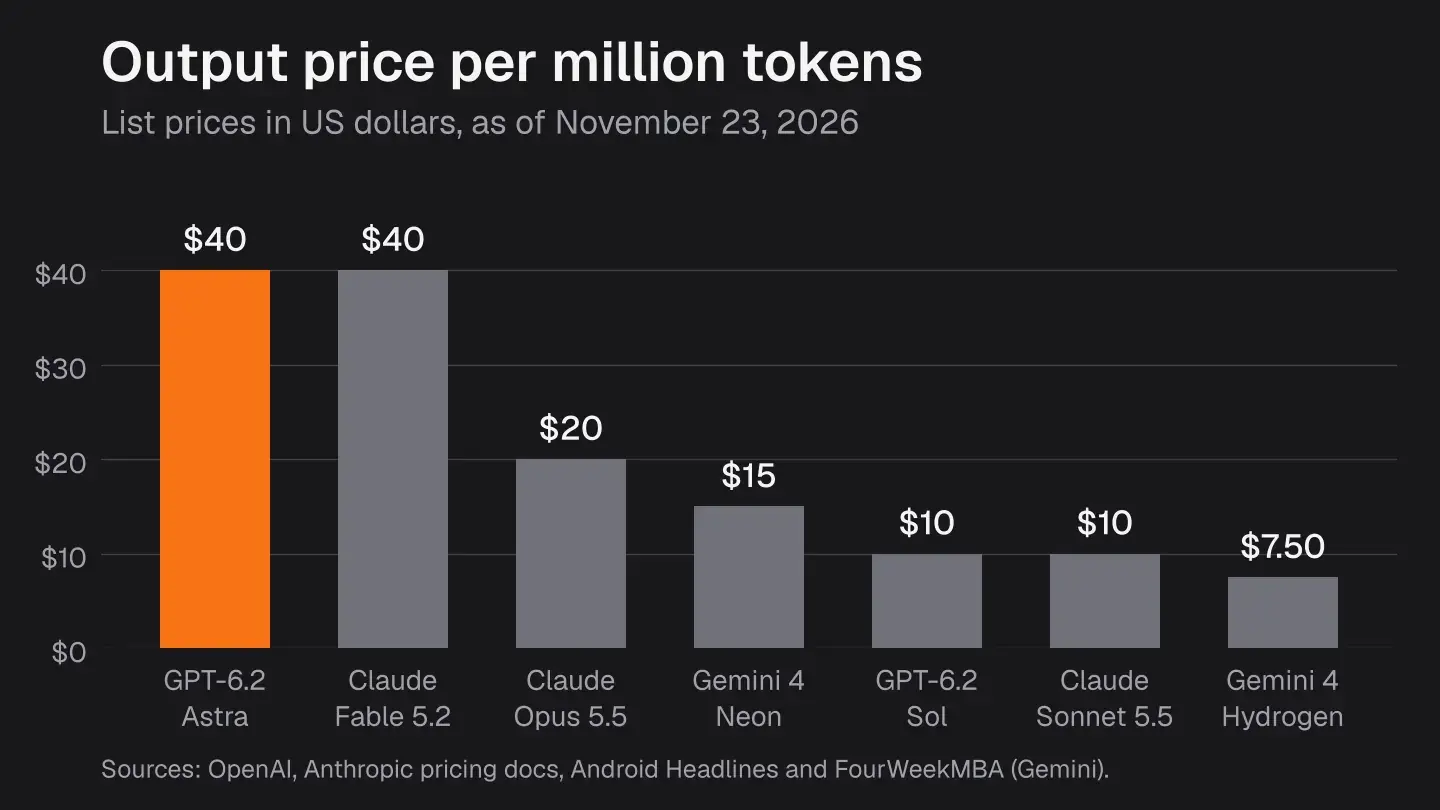
Three things stand out:
- Astra and Fable 5.2 cost the same. Both sit at $8 and $40. Claude Fable 5.2 has a cheaper cache read, at $0.20 against $0.40.
- Claude Opus 5.5 is half the price of Astra. Anthropic lists Opus 5.5 at $4 and $20, down from $5 and $25 for Opus 5.
- Sol and Sonnet 5.5 are priced identically at $2, $10, and $0.10 cached.
Gemini prices change on December 1
Google is ending introductory prices on part of the Gemini 4 family. According to Android Headlines (opens in a new tab), Gemini 4 Carbon, Google's strongest reasoning model, and Gemini 4 Argon rise from $2 input and $10 output to $4 and $20 on December 1, 2026. From then, Neon costs 25% less than Carbon. The report lists no change for Hydrogen. If you test Gemini this week, budget at the December price.
What does a typical monthly AI bill look like?
Per-token prices are hard to picture, so here is an illustrative example rather than a real customer. Take a customer support assistant that handles 10,000 conversations a month. Each conversation sends about 3,000 input tokens (instructions, a help article, and the chat so far) and gets about 600 output tokens back. That is 30 million input tokens and 6 million output tokens a month.
| Model | Input cost | Output cost | Monthly total |
|---|---|---|---|
| GPT-6.2 Astra | $240 | $240 | $480 |
| Claude Fable 5.2 | $240 | $240 | $480 |
| Claude Opus 5.5 | $120 | $120 | $240 |
| Gemini 4 Neon | $90 | $90 | $180 |
| GPT-6.2 Sol | $60 | $60 | $120 |
| Claude Sonnet 5.5 | $60 | $60 | $120 |
The example ignores caching, which would lower every row, because the instructions repeat in each conversation. The spread is the useful part: the same workload costs four times as much on a flagship model as on a mid-range one.
Should you use GPT-6.2 Astra or Sol?
Start with the cheaper tier and move up only where it fails. Most business tasks, such as answering customer questions, drafting emails, sorting tickets, or pulling fields out of documents, run well on Sol, Sonnet, or Neon. OpenAI's own figures make the same point: on Cognition's FrontierCode 2.0 coding benchmark, it reports Sol coming within 0.5 points of Astra at about one fifth of the cost.
Astra and the other flagships earn their price on work where a wrong answer is expensive: long autonomous coding tasks, complex research, or agents that plan many steps on their own. A practical setup sends routine requests to the mid tier and routes only the hard cases to the flagship. If you are deciding where AI should help first, our guide to choosing your first automation walks through picking a task that is worth the cost.
Whichever model you choose, protect the account that pays for it. Set spend limits and usage alerts, and keep one key per project, as described in our guide to protecting AI API keys.
Frequently asked questions
How much does GPT-6.2 cost?
In the API, GPT-6.2 Astra costs $8 per million input tokens and $40 per million output tokens, with cached input at $0.40. GPT-6.2 Sol costs $2 for input, $0.10 for cached input, and $10 for output. In ChatGPT, both models are available on the Plus, Pro, Enterprise, and Edu plans.
Is GPT-6.2 cheaper than Claude?
It depends on the tier. GPT-6.2 Astra costs the same as Claude Fable 5.2 and twice as much as Claude Opus 5.5. GPT-6.2 Sol costs the same as Claude Sonnet 5.5.
What is the difference between GPT-6.2 Astra and Sol?
Astra is OpenAI's most capable model, built for long and difficult tasks. Sol is four times cheaper per token and suits most everyday business requests. You can use both and route each request to the cheaper model that can do it well.
Will these prices change?
AI prices change often, and not always downward: Google is raising some Gemini 4 prices on December 1, 2026. Check the provider's pricing page before you commit to a budget.
Price is only half the comparison
GPT-6.2 makes OpenAI's flagship 20% cheaper, but it does not change the basic choice: a mid-range model for most work, a flagship for the hard cases, and caching wherever a prompt repeats. Run your own prompts on two or three models, measure the tokens they use, and compare the results with the tables above. The cheapest model is the one that does the job correctly the first time.
Sources & further reading
- OpenAI: Introducing GPT-6.2 Astra and Sol (opens in a new tab)
- Claude Platform Docs: Pricing (opens in a new tab)
- Android Headlines: Google Gemini 4 Neon release, pricing and features (opens in a new tab)
Prepared with AI assistance. Linked sources checked on Nov 24, 2026. Recommendations are editorial guidance; examples are illustrative. Cover artwork is a conceptual illustration, not a technical specification.
Want more of our articles in your Google results? Add RDR Digital as a preferred source (opens in a new tab)
Let’s talk about your next step.
Tell us what you’re working with and what you want to improve.

